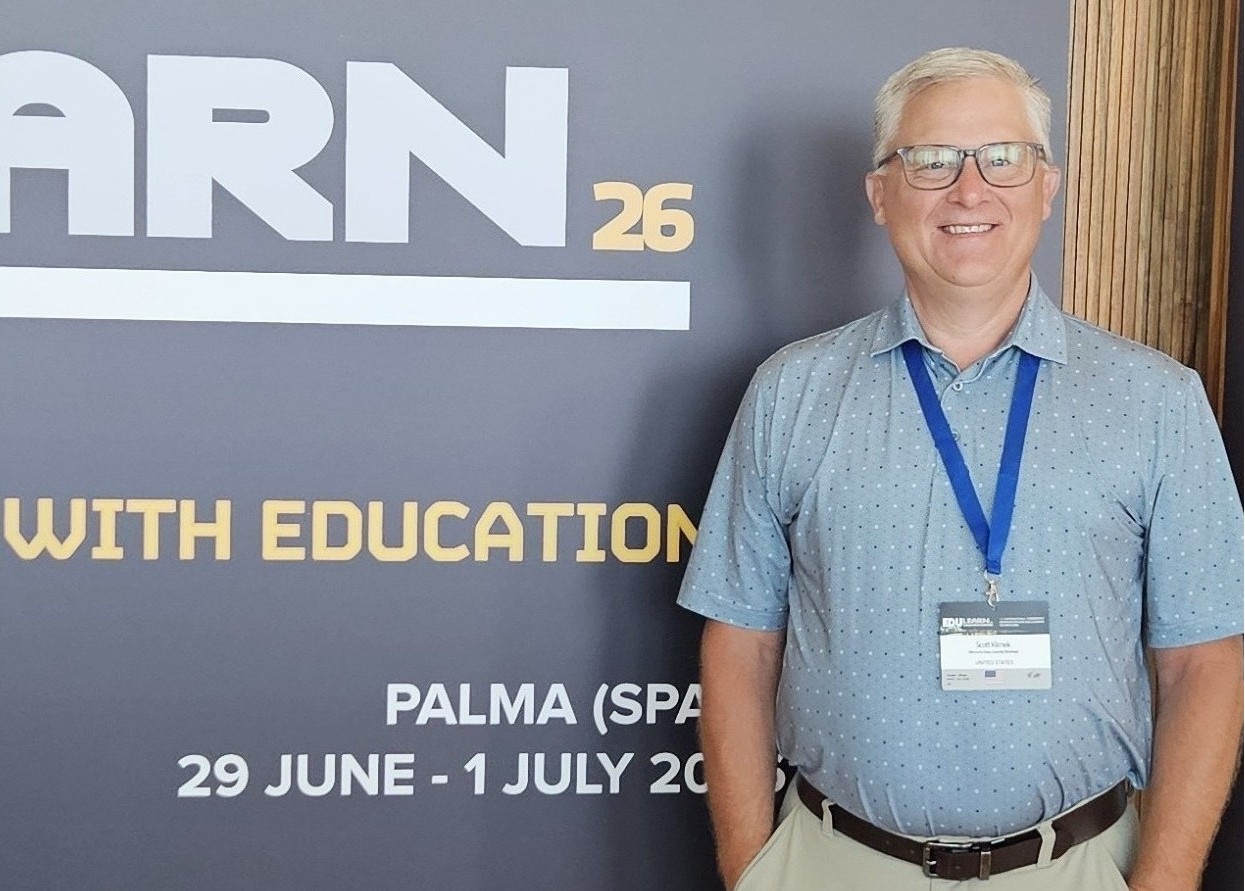
Dr. Scott Klimek presents The Kink in the Teacher Pipeline at international conference in Spain
Dr. Scott Klimek, Assistant Professor in the Nibbe School of Teaching and Learning at Minnesota State University Moorhead, recently presented research at the 18th International Conference on Education and New Technologies (EDULEARN26) in Palma de Mallorca, Spain.
His presentation, The Kink in the Teacher Pipeline, examined how teachers’ perceptions of their profession influence whether they encourage others to become educators. Drawing on survey data from 3,840 members of Education Minnesota, Klimek found that teachers who reported higher levels of professional esteem and prestige were significantly more likely to recommend teaching as a career.
In contrast, the study revealed substantial workforce instability that appears to be associated with lower perceptions of the profession’s esteem and prestige. More than 42% of respondents reported leaving one teaching position for another, 38% indicated they were considering leaving their current position, and nearly one in four reported considering leaving the profession altogether. These findings are especially significant because teachers’ intentions to remain in the profession emerged as one of the strongest predictors of whether they would encourage others to pursue teaching.
Klimek’s research also highlights an often-overlooked factor in the teacher shortage crisis. The messages current educators communicate about the profession, whether intentional or unintentional, can significantly influence future generations of teachers. Students and prospective teacher candidates are constantly observing how educators experience and talk about their work in classrooms across the nation. When teachers express stress, limited autonomy, frustration, or hesitation about recommending teaching as a career, those messages can shape how young people perceive the profession’s desirability and long-term sustainability. In this way, the everyday experiences and perspectives of teachers may influence not only who remains in the profession, but also who chooses to enter it.
The study further found that veteran teachers were among the least likely to recommend teaching as a career, a trend that appears to be linked to lower perceptions of professional esteem. This finding is particularly noteworthy because students frequently seek career advice from their most experienced teachers, giving these educators considerable influence over how the profession is viewed by future generations.
Klimek’s findings suggest that strengthening teachers’ professional esteem and public prestige may be critical not only for improving retention but also for attracting the next generation of educators. Ultimately, what students see and hear in classrooms today may help determine who chooses to teach tomorrow.